The call
It is 0214. Your crew is dispatched to a 58-year-old male with indigestion that started after a late dinner. He is pale, a little diaphoretic, and insists he is fine. His 12-lead does not suggest a STEMI, and the monitor's computer interpretation reads nonspecific T-wave abnormality. But the inferior T waves look too broad and too tall for the QRS complexes in front of them, and there is a hint of ST depression in aVL. Your gut says this is an occlusion.
Now run the same call with an AI model reading that tracing. Within seconds it flags a high probability of acute coronary occlusion and routes the ECG to the interventional cardiologist on call before you clear the driveway. That is no longer a thought experiment. On September 10, 2026, the FDA granted de novo authorization to Queen of Hearts, an AI ECG model built to detect STEMI and STEMI equivalents, and its developer is explicitly building for prehospital workflows (Powerful Medical, 2026).
Over my career I have watched new and old technology arrive on the squad and disappear from the squad: MAST pants, dobutamine, promethazine, video laryngoscopes, mechanical CPR, ePCR tablets, and more. Some changed how we practice and led to increased quality outcomes. Some ended up removed from service due to new research or ineffectively achieving the intended goal. This three-part series looks at where AI is likely to matter in first response, in critical care transport and in community paramedicine, and how to tell the difference between a tool that helps your patient and one that just adds noise.
What we mean by "AI"
Artificial intelligence is a marketing term as much as a technical one. For practical purposes, three categories matter:
- rules based software, such as traditional imbedded 12 lead tracing interpretation we see in Zoll and Lifepak functionality
- machine learning using large data sets to identified patterns, such as applications loaded with thousands of ECGs
- generative artificial intelligence which are large language models that work in conversational format such as Claude, Gemini and Open Evidence,
The distinction is important, in part, because he one succeeds and fails differently. A rules-based model fails the same way every time, a machine learning model can fail silently based upon flawed data seeding and generative AI models can hallucinate.
That said, humans also have inherent flaws that lead to misinterpretation or error such as anchoring bias, confirmation bias, the framing effect and omission bias – just to name a few. The point here is that whether human or technologically enabled there are risks, and our goal is to reduce risk and error rates by both understanding and applying the right tools.
Where AI shows up in first response
Technology is all around us and has been in use for many years. Visit your 911 center and you will see some of it in action. If your squad is part of a law enforcement unit, you know all about technology – such as license plate readers, speed detectors, and shots fired detectors. Figure 1 maps a single 911 call against the points where AI tools are being built or deployed today. Table 1 summarizes how mature each one is.
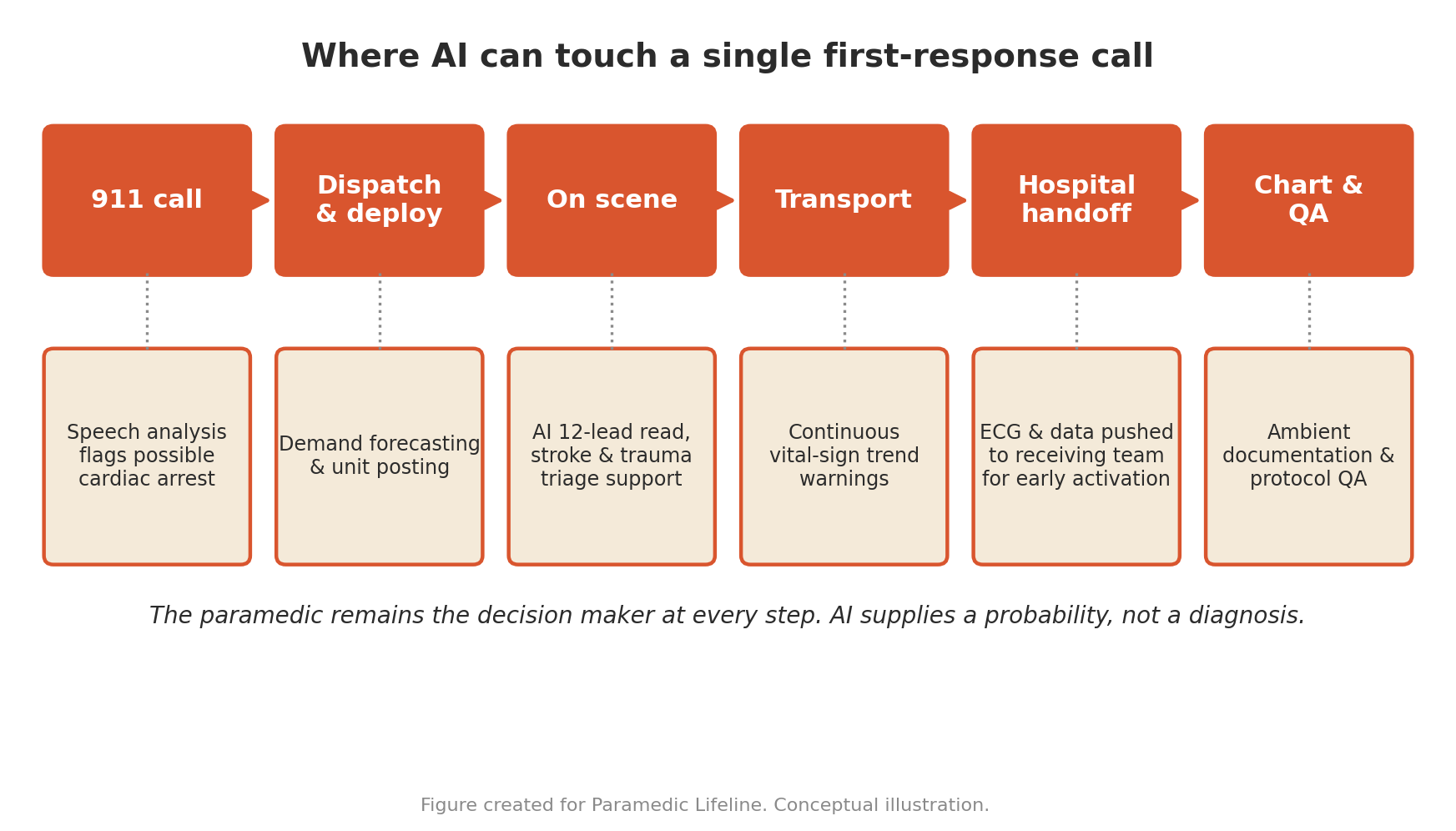
Figure 1. AI touchpoints across a single first-response call. Original graphic created for this article.
One tool that has the potential to create efficiency across prehospital emergency medicine is ambient listening and documentation tools. EMS call scenes vary in intensity and complexity. Many are wrought with high energy stress due to the emergent nature of the event – difficulty or absent breathing, traumatic injury, and other life-threatening scenarios. In a high paved, high stress environment it is easy to forget details that may be impactful at some point in the care continuum. Knowing that the patient’s father also suffered an MI at age 40 is not helpful on scene, but it is helpful later in the care pathway when they are at the hospital. An ambient listening device that collects relevant information and helps form this information into proposed medical documentation has extraordinary value.
The ECG lesson: Where AI is closest to changing practice
If one application is ready to change first-response care, it is the 12-lead. We have known for years that STEMI millimeter criteria miss a meaningful share of acute coronary occlusions. In a 2023 study in Nature Medicine, Al-Zaiti and colleagues derived and externally validated a machine learning model using prehospital ECGs from 7,313 consecutive chest pain patients across multiple sites (Al-Zaiti et al., 2023). The model outperformed practicing clinicians and widely used commercial interpretation systems in identifying occlusion MI. When its risk score was combined with the judgment of trained emergency personnel, it helped correctly reclassify about one in three chest pain patients.
Commercial tools have moved quickly since then. In a retrospective registry study across three U.S. primary PCI networks presented in 2025, the false-positive activation rate was 7.9% when the Queen of Hearts model was used and 41.8% when it was not (TCTMD, 2026). False activations waste resources and add to total health care costs. They also create anxiety for the patient and family, who fear the worst. Field diagnosis and activation remain the hallmark standard of achieving high performing street-to-treat reperfusion metrics.
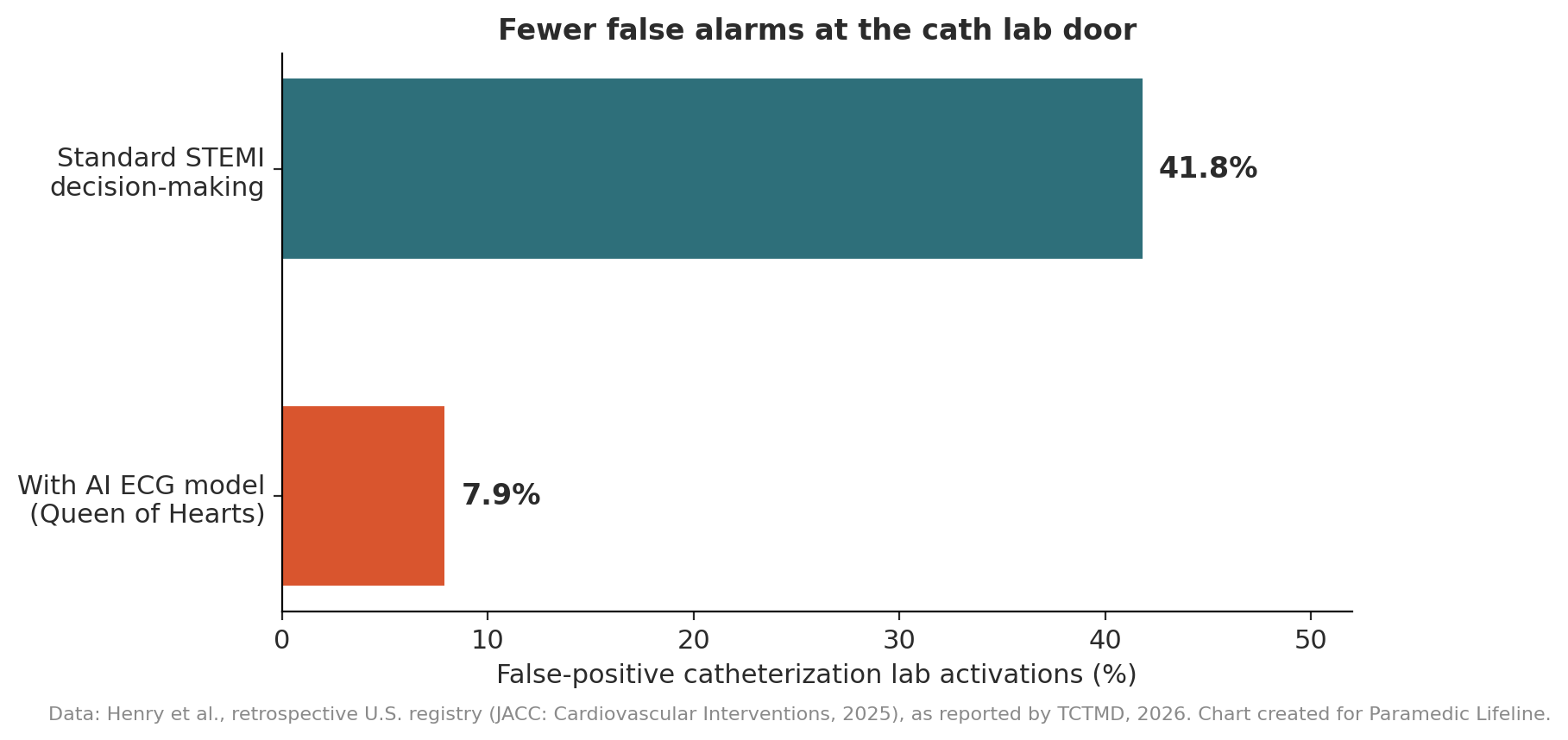
Figure 3. False-positive catheterization lab activations with and without an AI ECG model. Data from a U.S. registry study reported by TCTMD, 2026. Chart created for this article.
Practically speaking, even if an AI Agent makes a diagnosis that you wouldn’t have – for example stating an occlusion is likely when your initial read was that the ECG was normal clinical correlation remains necessary. We must treat the patient – if they are complaining of chest pain and diaphoretic and the ECG appears normal, they still need treatment. Oxygen, aspirin, nitroglycerin if appropriate or morphine sulfate. The paramedic still owns the patient outcome and needs to use the AI tool as an adjunct not a replacement.
How many times on a call have you obtained a 12 lead ECG, read the tracing or had an EMT collect the tracing and hand it to you? How many times after reading it have you handed it to another Paramedic and said – I see atrial flutter with occasional PATs – what do you see? This correlation and confirmation are similar to how you will or may be using an AI interpretative agent. The only difference is, the agent will have been trained on thousands of tracings – both common and uncommon.
Paramedic assessment of an AI output
Treat AI output the way you treat any other assessment tool: useful, fallible and subordinate to your clinical judgment. A practical approach:
- Know the tool's lane. What was it trained on, what is it cleared or validated for, and which patients were excluded? A model validated on adults with chest pain has not been validated on a 16-year-old with palpitations.
- Treat it like a vital sign, not a verdict. An AI result is one data point. Put it next to your history, your exam and your trend.
- When you and the machine disagree, lean toward the sicker possibility. If the AI flags occlusion and you are unsure, escalate. If the AI says normal and your patient looks sick, believe your patient.
- Document both. Record what the tool reported and what you did with it, including when you overrode it and why.
- Report the misses. Every system using AI needs a feedback loop through QA and medical direction, so false alarms and near misses are reviewed rather than forgotten.
Pros and cons
Table 2. Benefits and risks of AI in first response
Potential benefit | Real risk |
|---|---|
Earlier recognition of time-sensitive conditions such as occlusion MI | Automation bias: accepting the output without thinking it through |
Fewer false activations that erode trust with receiving teams | Alarm fatigue when thresholds generate too many false positives |
Consistent performance at 0300 on the fourth call in a row | Weaker performance in patient groups missing from the training data |
Less time charting and more time with patients | Documentation errors that carry your signature |
Better data for QA, research and deployment | Privacy, data security and unclear liability when the tool is wrong |
Evidence and Reality
AI in prehospital care is promising and early. So too is AI across hospital care and inpatient medicine. However, there is a risk of prehospital being left behind because adoption and implementation are both costly and require technology team integration. Some prehospital programs are likely to leverage AI solutions by integrating with hospital systems. Other large urban and municipal systems – think LAFD, NYFD, DFW, Miami-Dade are positioned to leverage scale and resources to adopt technology. It will be much harder for a small rural ALS agency to obtain and deploy this technology in the near term.
Installment number two will focus on AI in the ambulance and installment three will address application of AI in community paramedicine,
References
Al-Zaiti, S. S., Martin-Gill, C., Zègre-Hemsey, J. K., Bouzid, Z., Faramand, Z., Alrawashdeh, M. O., et al. (2023). Machine learning for ECG diagnosis and risk stratification of occlusion myocardial infarction. Nature Medicine, 29(7), 1804-1813. https://doi.org/10.1038/s41591-023-02396-3
A systematic literature review of artificial intelligence in prehospital emergency care. (2025). Big Data and Cognitive Computing, 9(9), 219. https://www.mdpi.com/2504-2289/9/9/219
Blomberg, S. N., Christensen, H. C., Lippert, F., Ersbøll, A. K., Torp-Petersen, C., Sayre, M. R., Kudenchuk, P. J., & Folke, F. (2021). Effect of machine learning on dispatcher recognition of out-of-hospital cardiac arrest during calls to emergency medical services: A randomized clinical trial. JAMA Network Open, 4(1), e2032320. https://doi.org/10.1001/jamanetworkopen.2020.32320
Kashiouris, M. G., Miner, A., Saleh, S., Scripps, M., Stanton, L., Samuel, G., & Dibble, B. (2026). The effect of ambient artificial intelligence documentation on clinician workload, efficiency, and patient experience in a multisite emergency department network. Advance online publication. https://doi.org/10.1055/a-2939-3038
Mapping artificial intelligence applications for clinical and operational decision support in prehospital emergency medical services: A scoping review. (2026). PubMed ID 42561610. https://pubmed.ncbi.nlm.nih.gov/42561610/
Powerful Medical. (2026, September 10). Powerful Medical receives FDA De Novo approval for PMcardio "Queen of Hearts," its AI ECG model for detecting acute heart attacks [Press release]. Business Wire. Link
TCTMD. (2026). FDA clears first AI-ECG model for acute MI detection. https://tctmd.com/news/fda-clears-first-ai-ecg-model-acute-mi-detection
U.S. Food and Drug Administration. (n.d.). Artificial intelligence-enabled medical devices. https://www.fda.gov/medical-devices/software-medical-device-samd/artificial-intelligence-enabled-medical-devices