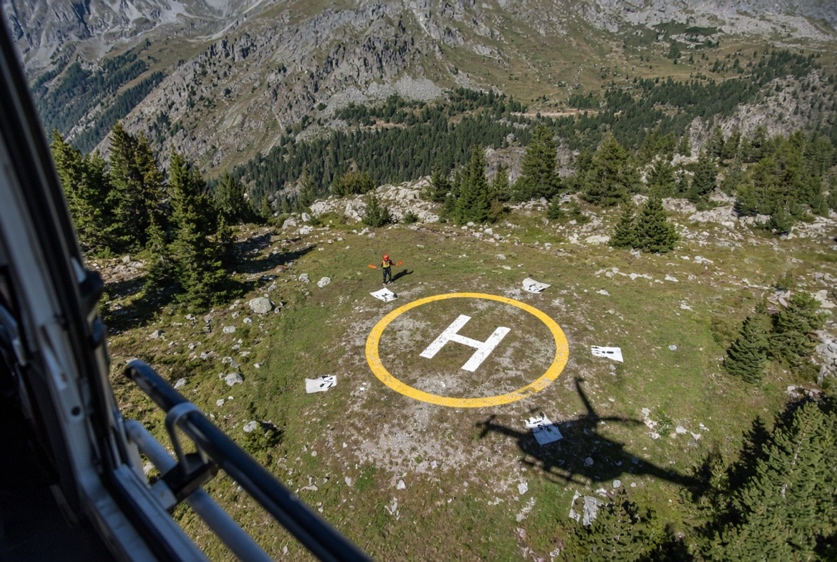
This addendum goes deeper into the aviation side of a hoist or short-haul mission: rotor wash behavior; how to safely move around a running aircraft; why aircraft performance limits the mission; how the hoist system and its crew work; and what the emergency procedures look like from the ground. It is written for the paramedic who will be on the ledge, not for the aircrew, and it does not replace agency training or an aircraft’s flight manual. [Procedures and wording differ between agencies; the examples here come from direct experience, published operating plans and manuals and are labeled as examples.]
Rotor Wash: What Is Coming Down at You
A hovering helicopter stays in the air by driving a column of air downward. That column, the downwash, hits the ground and spreads out sideways as outwash. Its strength depends on the aircraft’s weight, the size of its rotor and the density of the air, so a heavy military-type aircraft such as a UH-60 produces far more than a light single-engine helicopter such as the Bell 407 or the Airbus H125.
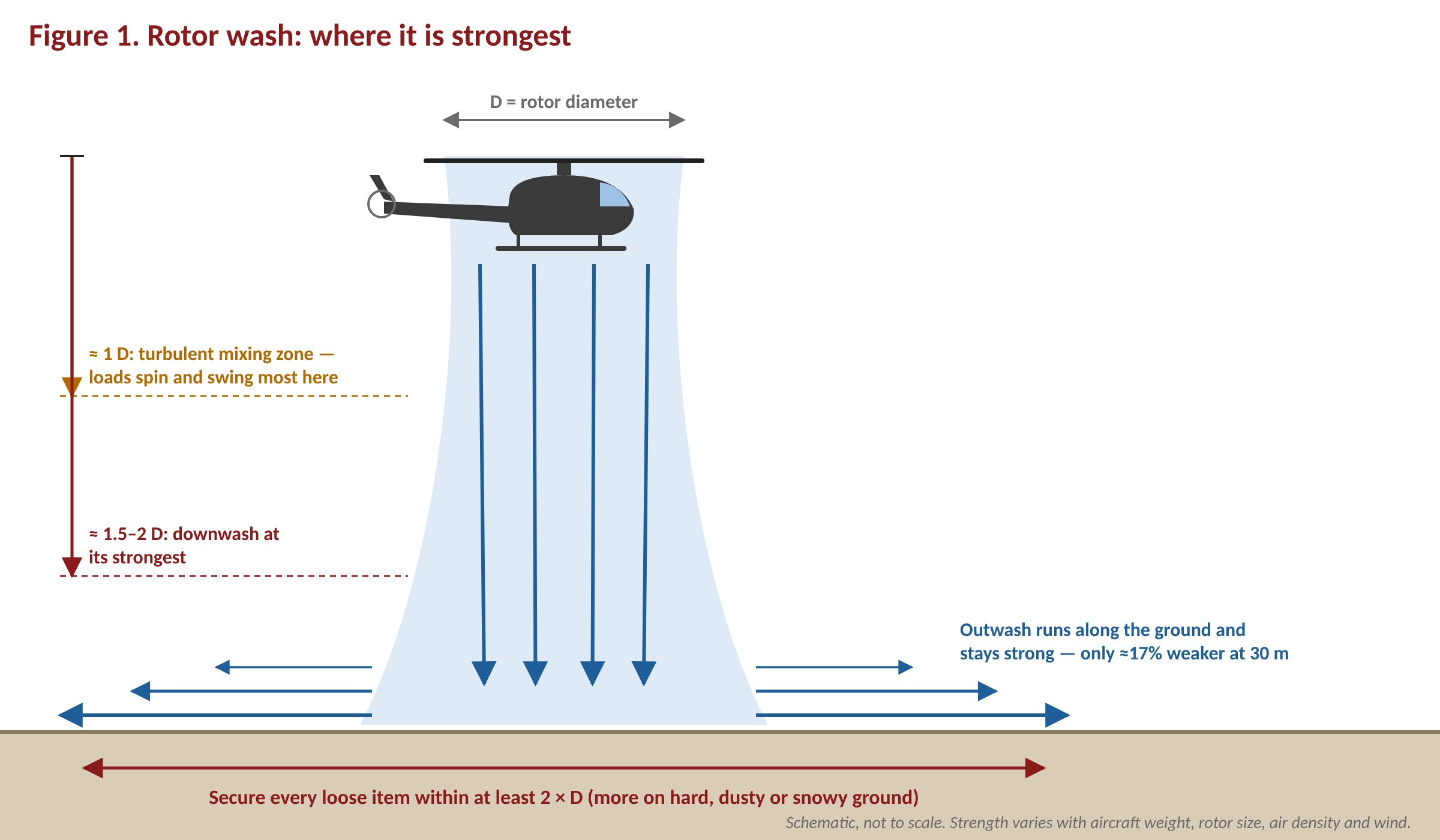
Figure 1. Rotor wash. Downwash is strongest about 1.5 to 2 rotor diameters below the aircraft; the zone about one diameter below is the most turbulent, which is where suspended loads tend to spin and swing.
Three practical points follow from the physics:
- It peaks below the aircraft, not at it. Safety analyses of air ambulance downwash injuries note that downwash reaches its peak roughly 1.5 to 2 rotor diameters below the aircraft before spreading out. A hoist hover often puts the ground team right in that band.
- It travels a long way. The same analyses found that at about 30 meters from the aircraft the flow was only about 17 percent weaker. Terrain, rock walls and trees can funnel it and make it stronger in unexpected places. Survey the scene from the ground, as the HEMS crew does the same from the air.
- It throws things. Documented air medical cases include bystanders struck by rolling equipment, a pedestrian blown over and seriously hurt, and a fatal injury to a third party near a hospital landing site. On a mountain the projectiles are rocks, branches, ice, packs, foil blankets and litter straps.
Secure every loose item within at least twice the rotor diameter of the hover point, and farther on loose, dusty or snowy ground. Weight down or stow foil blankets before the aircraft arrives; they act like sails. Everyone on scene, including the patient, wears eye protection and a helmet. If you are blinded by debris, stop, crouch and wait for it to settle. Do not walk blindly toward or away from the aircraft. It is not uncommon for crews to establish an LZ a distance away from the “accident scene” to help with minimizing the risk of downwash projectiles.
Cold and noise. Downwash strips heat from a wet or exposed patient quickly, so wrap the patient before the hover. Noise makes voice communication on the ground nearly impossible; agree on hand signals with your team before the aircraft arrives. The time to establish this communication is prior to any event, similar to hand signal routines used in interior fire attack. [See figure 7]
Moving Around a Running Aircraft
Sometimes the aircraft can land or hold a toe-in near the scene, and ground personnel must approach it. The rules are simple and absolute.
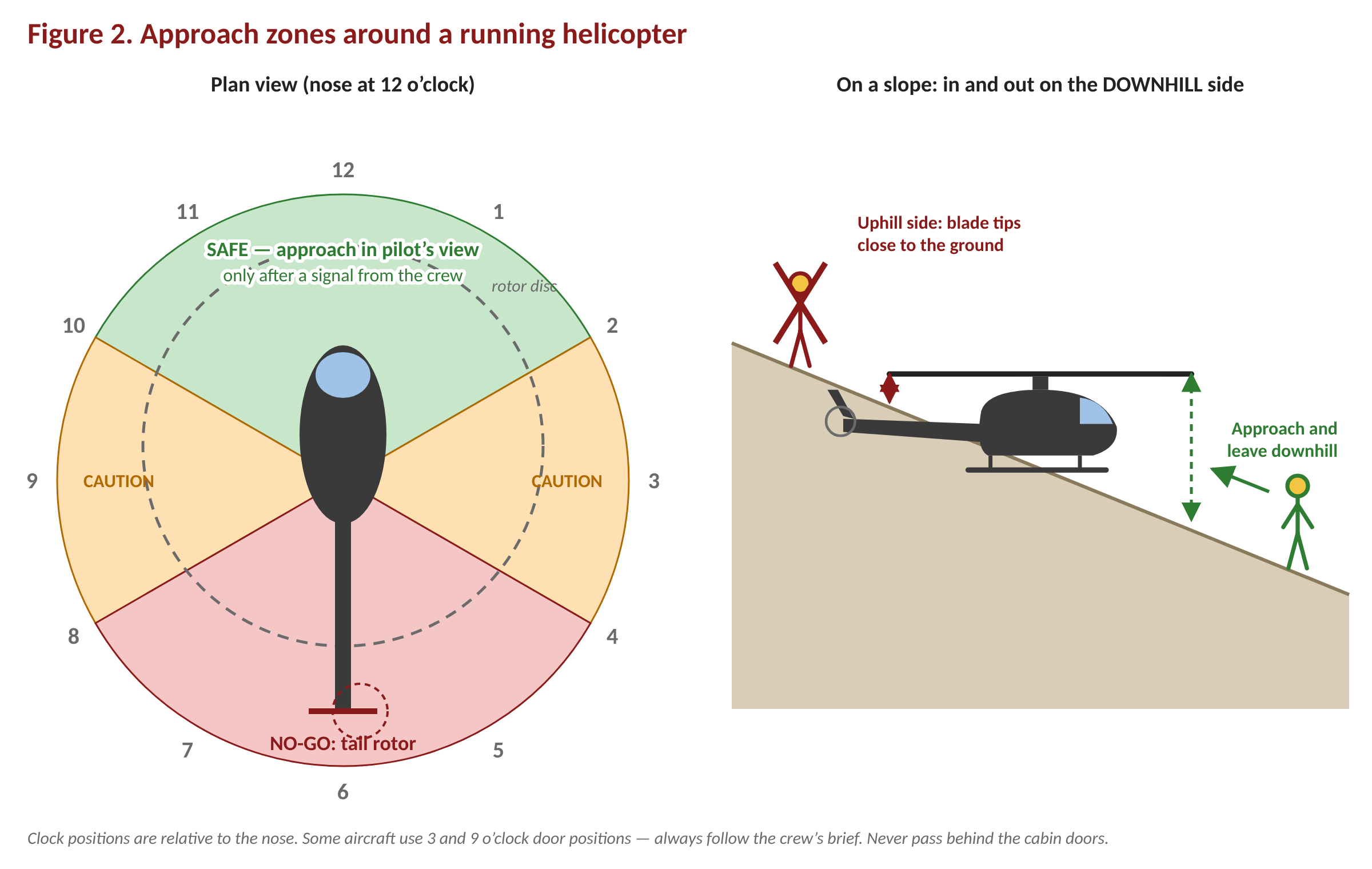
Figure 2. Approach zones. Approach in the pilot’s field of view, only on a signal from the crew, and never toward the tail rotor. On a slope, approach and leave on the downhill side.
- Approach after crew signal. By day, give a thumbs-up and wait for the pilot to return it. By night, flash a light at the ground and wait for the landing light to flash back. Never enter the rotor disc without express permission.
- Stay in the pilot’s view. The usual entry points are the 10 o’clock and 2 o’clock positions relative to the nose; some aircraft use 3 and 9 o’clock door positions. Never go farther back than the cabin doors. Reference your regional rotor procedures to confirm clock position.
- Avoid the tail rotor. The tail rotor is nearly invisible when spinning and sits at head height on many aircraft. Do not duck under the tail boom or pass behind the aircraft. If you must cross to the other side, go around the front.
- On a slope, use the downhill side. The rotor disc stays level while the ground rises, so blade tips on the uphill side can pass within reach of a person standing upright.
- Carry equipment low and horizontal. Never carry IV poles, splints or litters vertically. Long items need two people, one at each end.
Aircraft Performance: Why the Pilot May Say No
The pilot has the final say on whether a hoist or short-haul can be done safely. These are the factors behind that decision.
- Hover out of ground effect. A helicopter hovering close to the ground gets extra lift from its own downwash bouncing back up. Over a ledge, a canopy or a cliff, at hoist height, it gets none. A hover out of ground effect (HOGE) needs more power than landing or a low hover, so crews confirm that HOGE is possible before committing. The National Park Service short-haul plan, for example, requires a HOGE power check with a positive rate of climb near the site.
- 3H - Hot, high and heavy. Thin air means less lift and less engine power. Every aircraft has hover performance charts; the FAA’s Helicopter Flying Handbook gives an example in which a light helicopter at 9,000 feet and 15 °C cannot hover out of ground effect until about 70 pounds are removed. Fuel, crew, the rescuer, the patient and equipment all count. Expect the crew to ask for weights pre-flight, and confirm on arrival.
- Power reserve. Agencies set a minimum power margin before committing to a hoist. Many require a minimum 10 percent reserve at the power check. Again, confirm local procedures assure understanding.
- Wind and descent. Pilots prefer to hover into the wind. A slow descent with a tailwind can lead to vortex ring state (settling with power), in which the rotor descends into its own downwash and loses lift. It typically needs low airspeed (under about 30 knots) and a descent rate above about 300 to 500 feet per minute, and recovery uses height the aircraft may not have near terrain.
- Engine failure in a hover. Every helicopter has a height–velocity diagram, sometimes called the “dead man’s curve,” that shows combinations of height and airspeed from which a safe autorotation after an engine failure is unlikely. A stationary hover at typical hoist heights sits in or near that area for a single-engine aircraft. That is why crews keep hover time short, prefer twin-engine aircraft for hoisting, and some hover 40 to 50 feet above treetops rather than just over them to leave room to recover. Height provides time when something goes wrong.
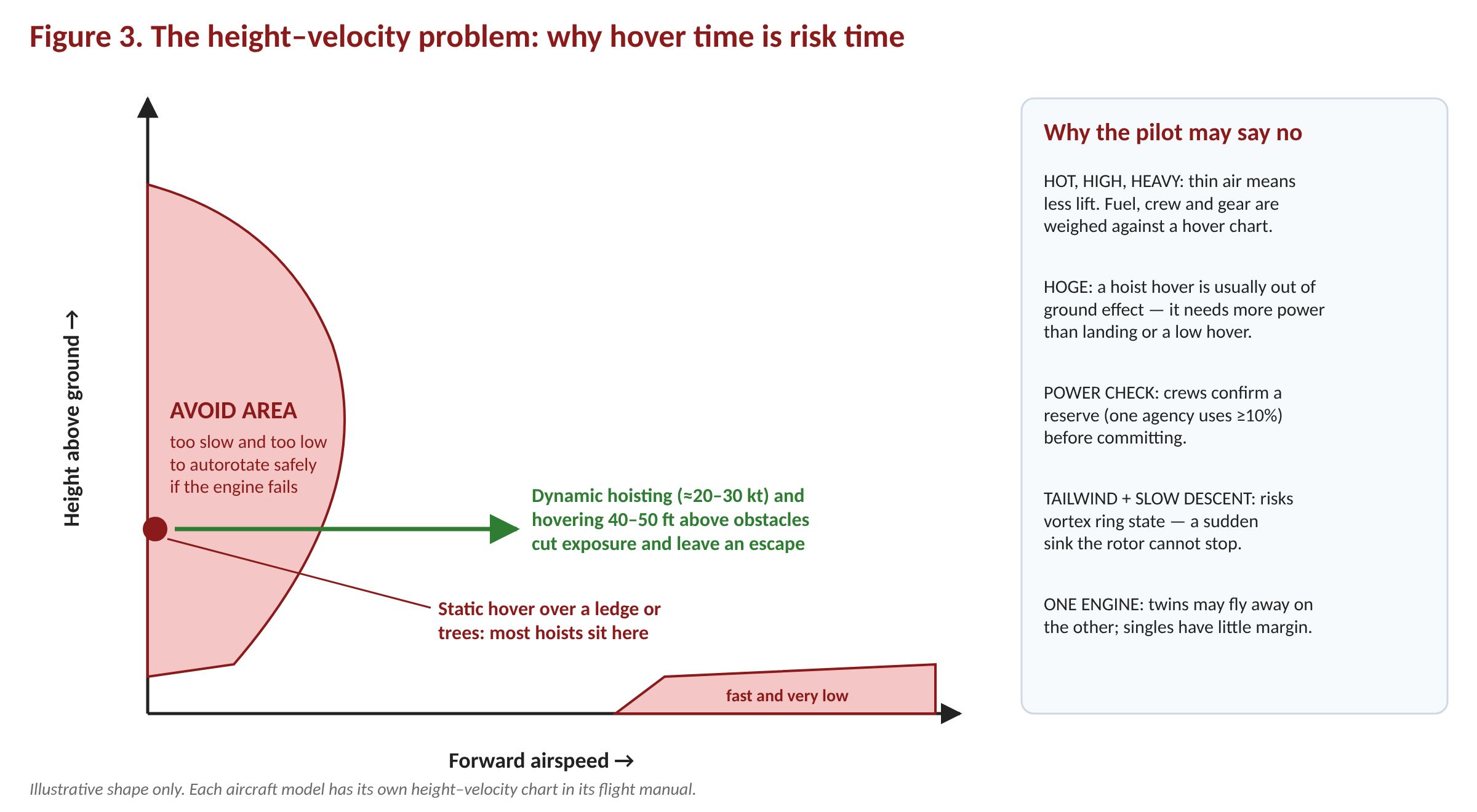
Figure 3. The height–velocity problem. Illustrative shape only; each aircraft has its own chart. Static hovers at hoist height sit in or near the avoid area of a single-engine aircraft, so hover time is risk time.
For the ground medic, the lesson is that every minute of hover is exposure. Have the patient treated, packaged and ready before the aircraft comes back in. Use agreed upon radio frequency for confirmation ahead of the rotor returning to scene hover.
The Hoist System
A rescue hoist is a powered winch mounted above the cabin door. It pays out a steel cable with a hook at the end. Capacities vary by model and installation: the hoist may be rated to 450 – 600 pounds with 150 feet of usable cable. Estimate weight to include patient and equipment/packaging.
Key components and features the ground team should recognize:
- Hook: A spring-loaded safety hook that only the trained rescuer opens and closes. Rescuers clip to a designated attachment point on their harness; patient devices are attached and checked by the rescuer, never by the ground team.
- Cable: Steel cable is strong but vulnerable. Rubbing against rock, ice or branches damages it, and slack can catch on vegetation. Hoist operators “own the cable,” keeping enough slack to allow for aircraft drift without letting it snag. Ground personnel keep their hands off it unless told otherwise.
- Shear: Hoists have an emergency shear, often a small explosive charge that severs the cable in one action, plus manual cutters. Crews brief a clear command such as “cut, cut, cut” and locate the switch before flight. Cutting with someone on the hook is a last resort, used when a snagged cable threatens to bring the aircraft down. Scene safety remains a primary foundation of rescue.
- Static: A hovering aircraft builds up a static charge that can reach hundreds of kilovolts relative to the ground. The hook, or a discharge line hanging below it, must touch the ground before anyone grabs it.
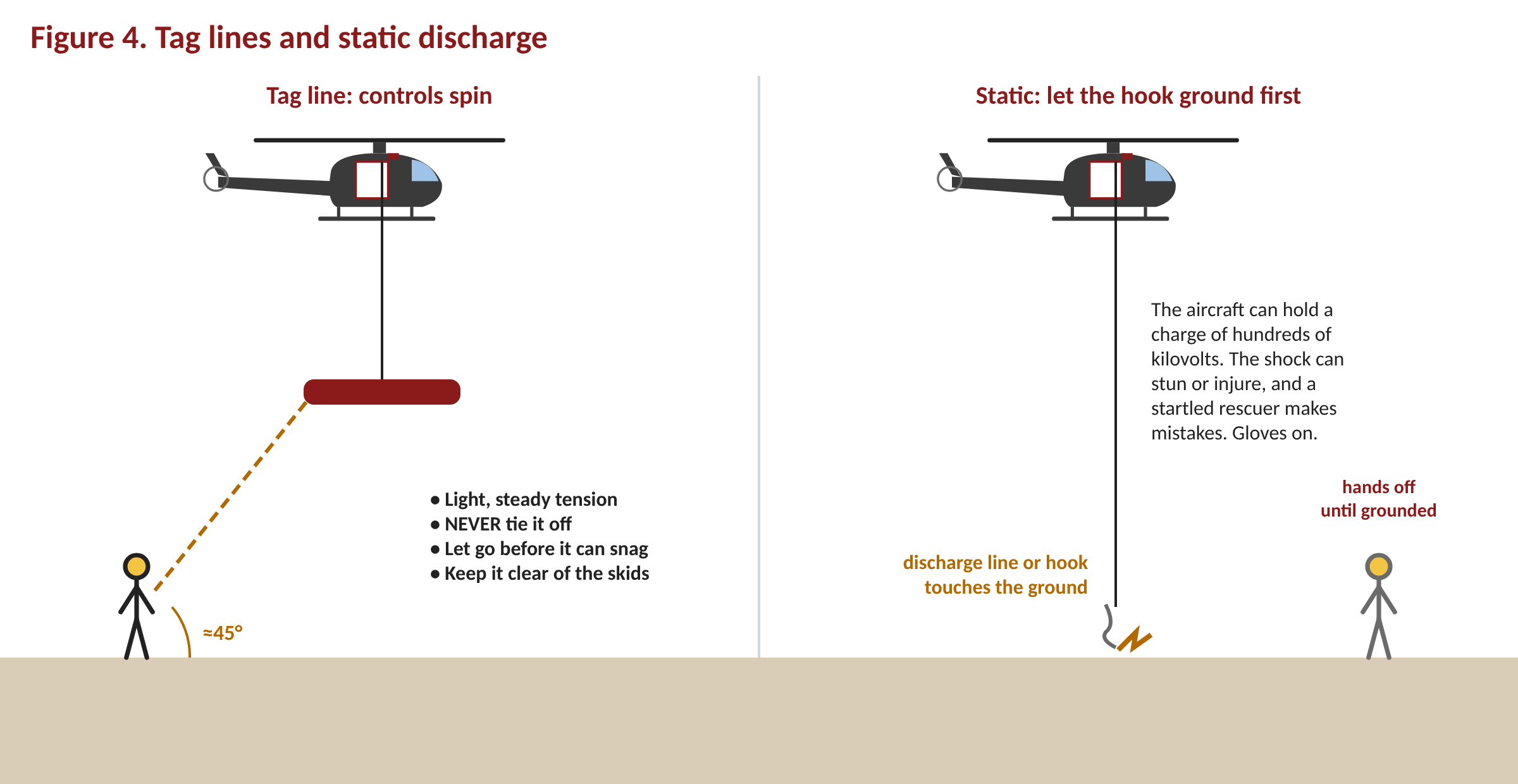
Figure 4. Tag lines and static discharge. A tag-line tender at roughly 45 degrees keeps light tension to stop the litter spinning and never ties it off. Nobody touches the hook or cable until it has grounded.
Insertion and Recovery, Step by Step
Every agency has its own checklist which should be referenced. The below is a common workflow that depicts the insertion, hoist and recovery process for a short-haul operation.
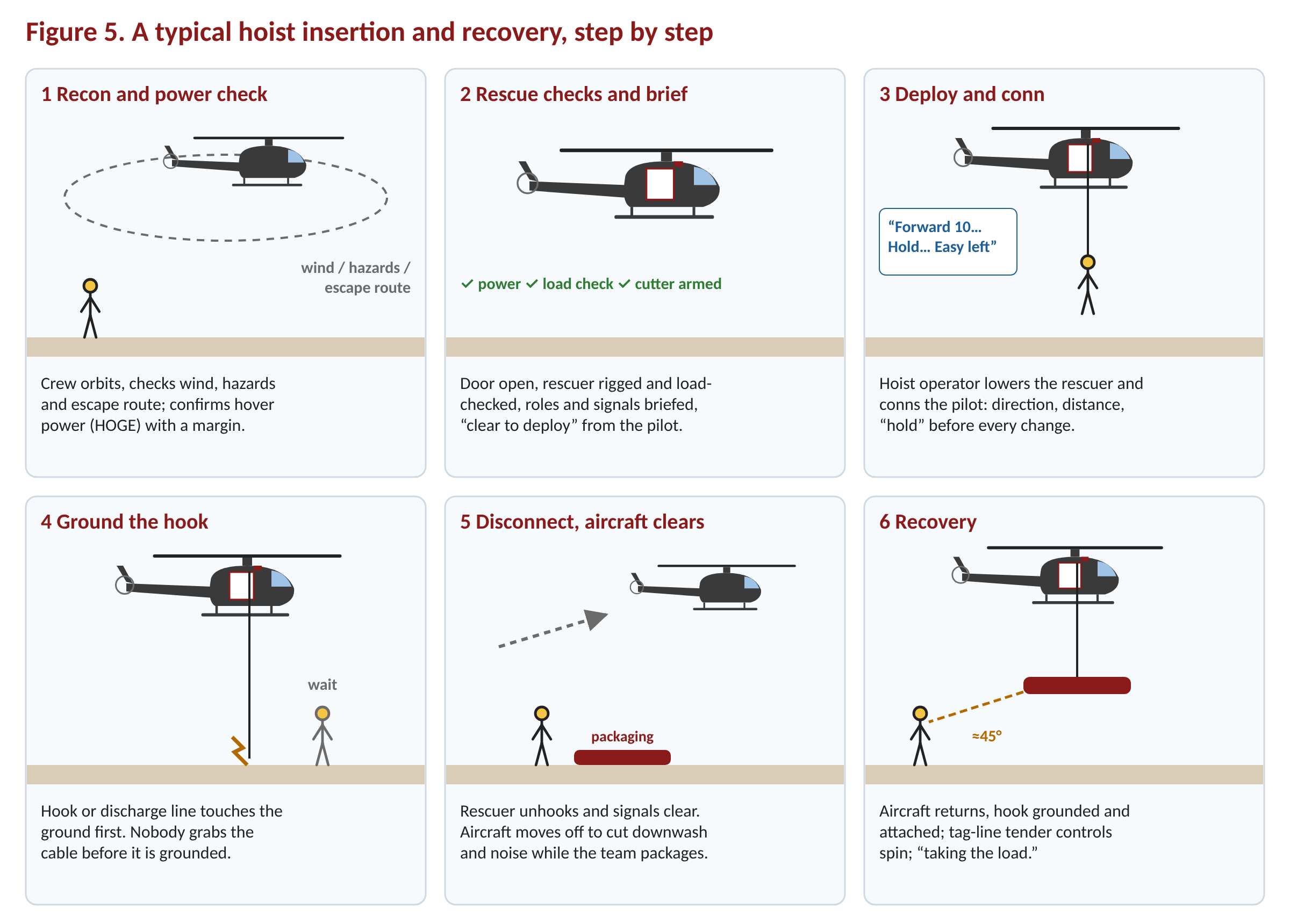
Figure 5. A typical hoist insertion and recovery. Wording and the order of checks vary by agency.
- Reconnaissance: The crew orbits the scene to assess wind, terrain, obstacles, wires and an escape route, picks the hover point, and runs the power check. This is literally the survey the scene phase.
- Rescue checks: The flight technician opens the door and the aircraft slows, the crew completes the hoist checklist, and the risk assessment is agreed by everyone on board. This is another step in continued mission acceptance. Once power is confirmed, and the rescuer is rigged to the hook a load check is completed while the rescuer is just a few feet below the skid door. This is an important step where mission abort or other decisions can be made rapidly before commitment. Nothing ever proceeds until the pilot gives the order “clear to deploy.”
- Deployment and conning: The hoist operator lowers the rescuer while directing the pilot, who usually cannot see below the aircraft – although modern aircraft may have a camera. Commands give a direction and a distance in feet, and a “hold” comes before any change of direction. In a cliff or steep slope scenario, the rescuer is often placed slightly above and to one side of the patient rather than directly over them.
- Grounding and disconnect: The hook grounds first. The rescuer lands, establishes footing, unhooks and signals clear. The aircraft often moves away to reduce downwash and noise while the team works.
- Packaging: The rescuer and ground team package the patient in the appropriate device. Initial care should have already been performed at the BLS and ALS level. However, in some cases the rescuer deploying is the only such trained rescuer and must perform care ahead of hoist.
- Recovery: The aircraft returns, the hook grounds (a necessary step each time) and the rescuer attaches the patient device and himself. On the rescuer’s signal, the operator calls “taking the load,” lifts the load a few feet to check stability, then raises it. A tag-line tender controls spin until the load is above the obstacles.
- Departure checks: In the cabin, the crew secures the hoist, closes the door and safes the cable cutter before forward flight. At this point the ALS care team can begin additional assessment, care and treatment. .
Communication
The pilot flies the aircraft but often cannot see the load; the hoist operator sees the load but does not fly. Conning is the structured and standardized voice guidance and directional commands provided by the hoist operator to the pilot to position and hold the aircraft over target. Commands such as right-two, down-five or easy left help align concise positioning. A key goal is keeping the hoist cable plumb. If you have never used a plumb bob you should experiment, Grab 1 meter of string, and tie a weighted object to the end then watching the object sway until gravity and alignment eliminate most movement along the x and y axis (the z axis being the string). In a controlled and isolated manner this is essentially what the pilot and hoist operator are fighting – adding wind, downwash, temperature and distance variability.
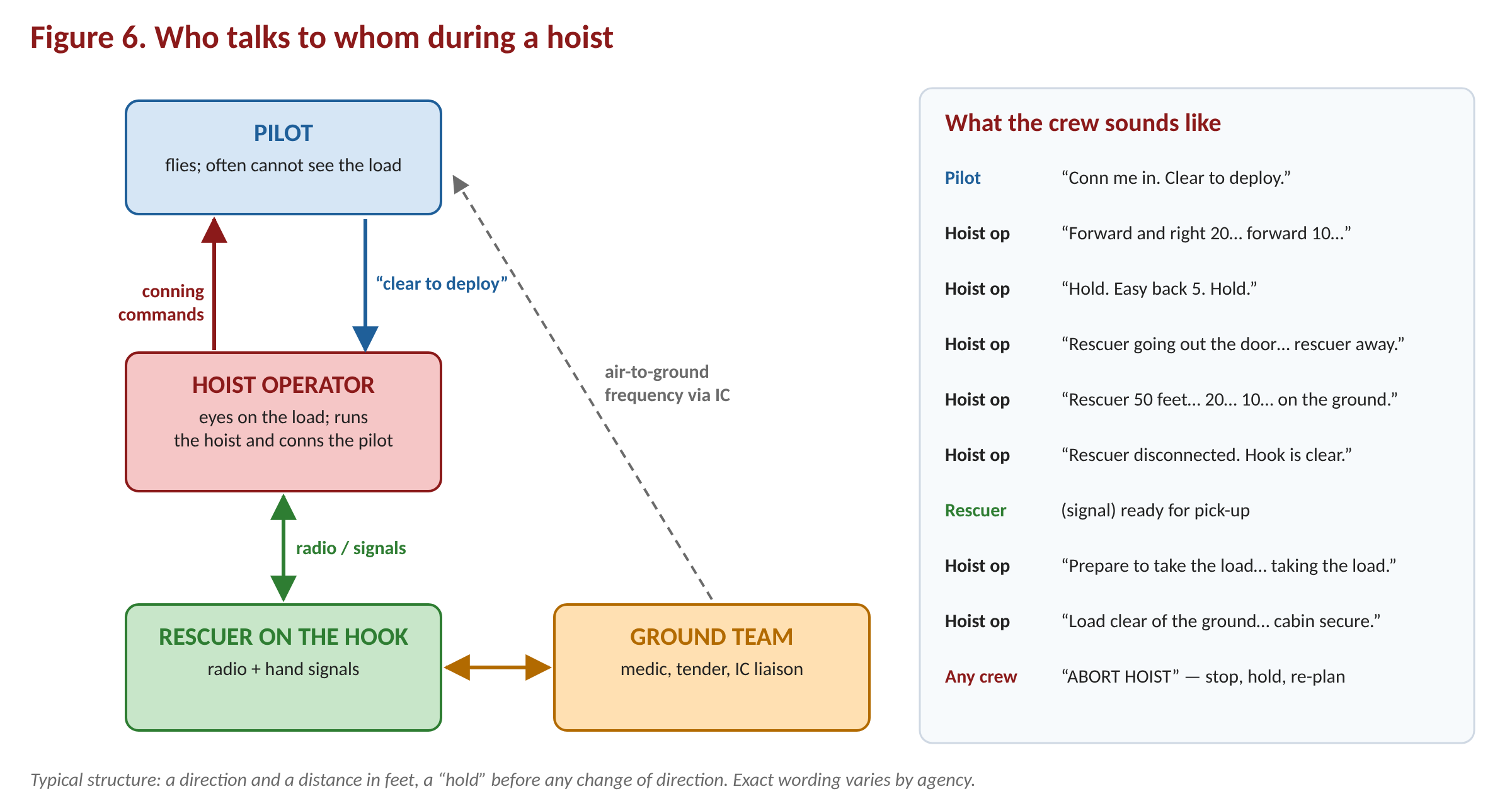
Figure 6. Who talks to whom. Sample phrasing adapted from a published sheriff’s air unit hoist manual; exact wording varies by agency.
The ground team usually talks to the aircraft through an air-to-ground frequency coordinated by incident command, and talks to the rescuer face to face once they are on the ground. Keep that frequency clear: the plan restricts it to emergency traffic during an operation. If radios fail, hand signals take over, and loss of radio does not automatically stop an evolution already in progress.
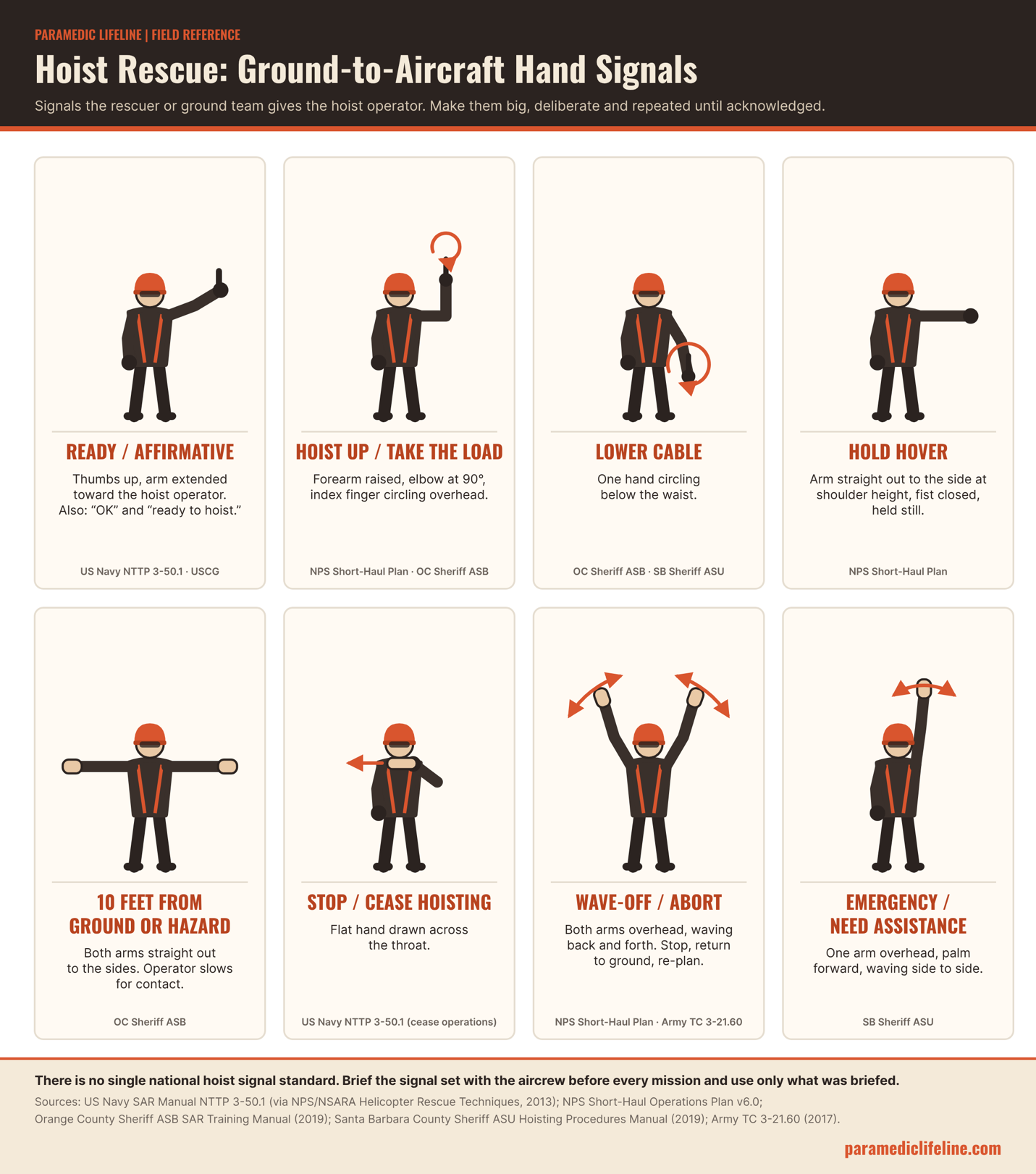
Figure 7.
Static and Dynamic Hoisting
There are two primary hoisting modalities – static and dynamic. In a static hoist the aircraft holds a steady hover over the target while the cable goes up or down. In a dynamic hoist the aircraft keeps moving forward on a shallow approach, lowering or raising the load as it decelerates toward, or accelerates away from, the hover point.
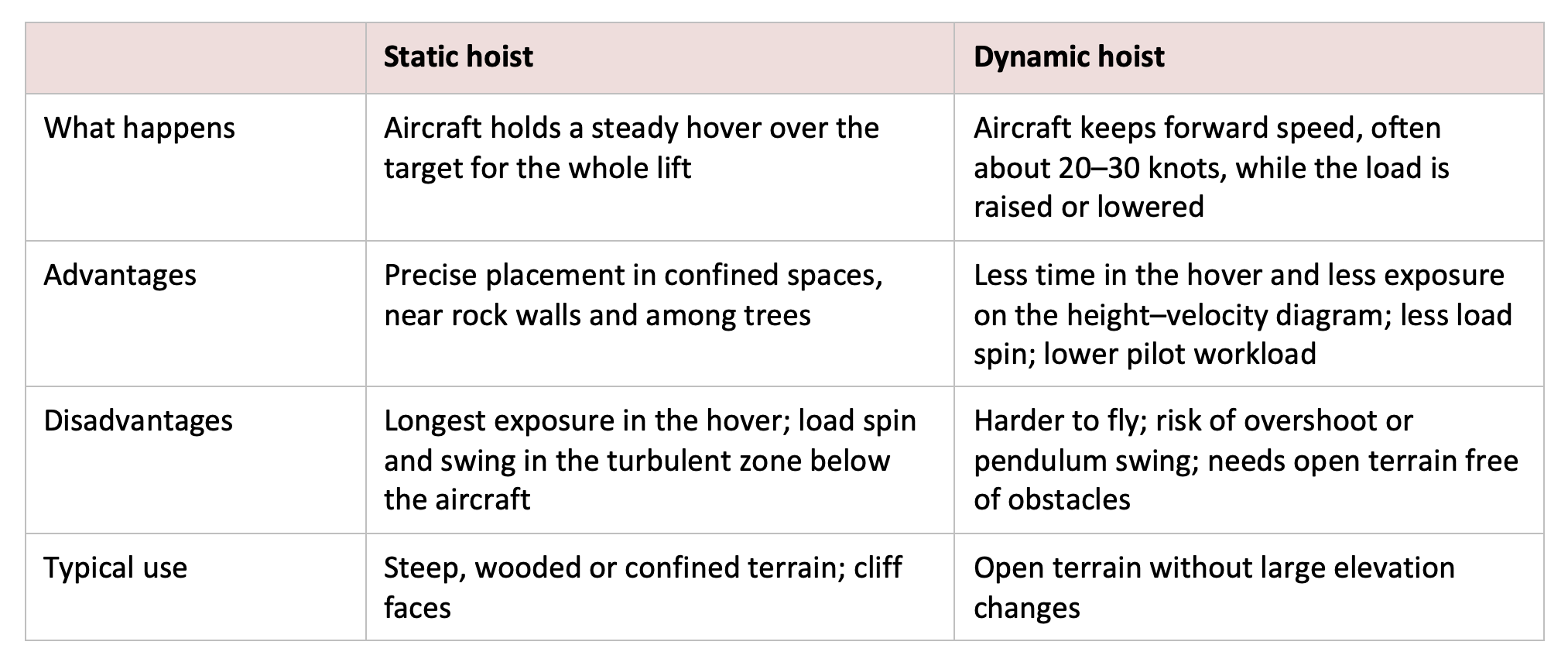
Many crews combine the two: lowering the rescuer dynamically to a safe height above the obstacles, then finishing the descent from a static hover. As with all elements of a hoist or insertion rescue it is important to assure all understand the plan, and any contingency plans before launch and initiation.
Short-Haul Specifics
Short-haul uses no winch, so its rules focus on the rope, the attachment and the flight to the landing zone. The NPS (National Park Service) short-haul operations plan is a useful example for reference. Link here: NPS. The rope attaches to dual cargo hooks with independent releases, and the load must take two separate, independent actions to jettison, so that one mistaken switch cannot drop it. Life-safety equipment is built to a 5:1 safety factor. Forward speed with the rope deployed must not exceed 52 knots (60 mph). It may surprise that an unweighted rope carries at least 12 pounds of ballast, so it hangs straight. The key medical difference from a hoist is that the patient stays outside the aircraft, exposed to wind and cold, until the landing zone. The patient should be packaged for the flight not just the hoist element. This includes a hypothermia wrap, and any other supportive care such as oxygen, IV, non-invasive monitoring, splints or ventilators.
Emergencies the Ground Team Should Understand
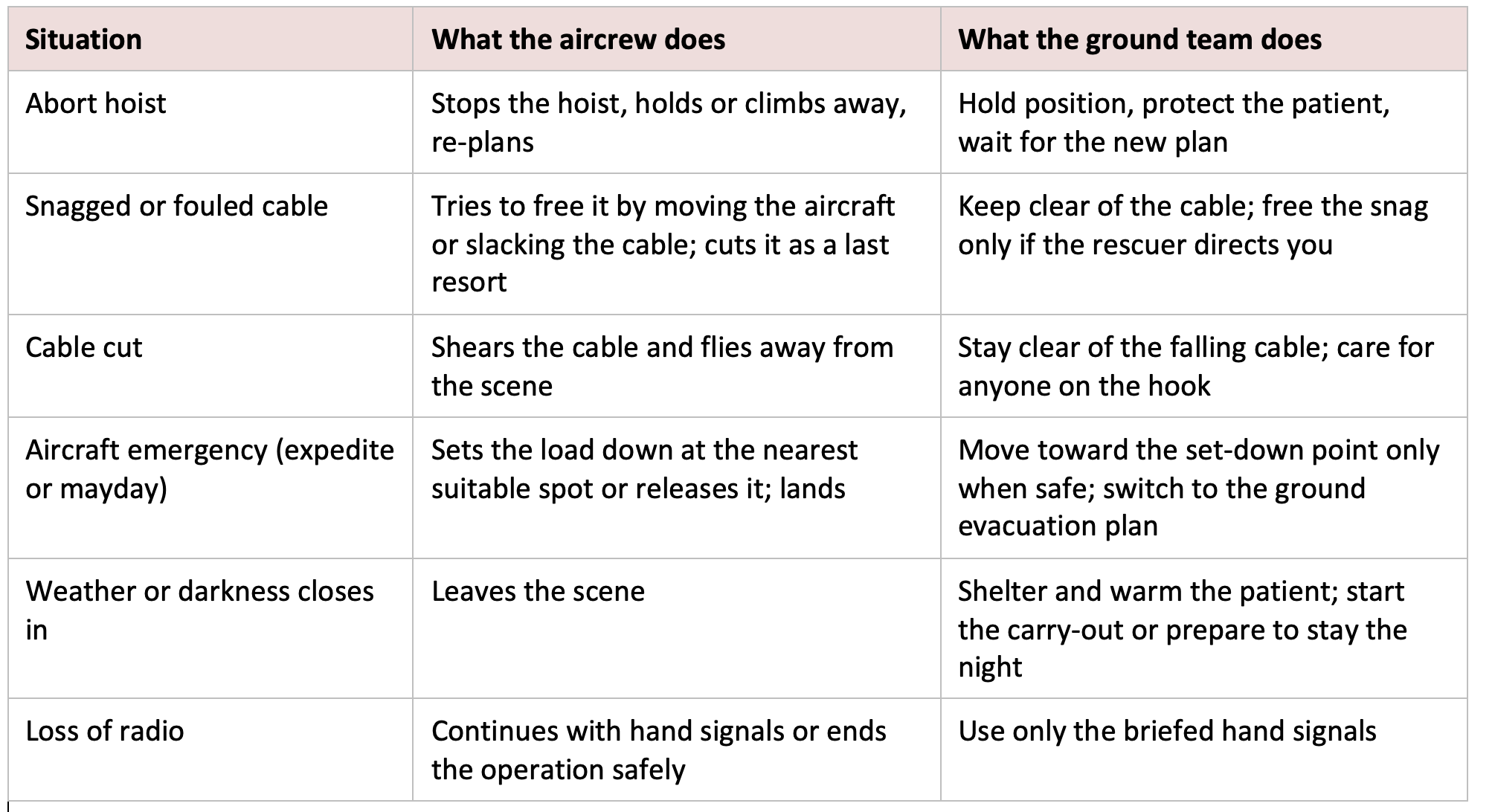
Ground Crew Quick Reference
Each rescue operation via helicopter requires detailed training, planning and execution. Uncertain and unstable environments, unfamiliar terrain, and ground crews that have not necessarily trained with the air-crew combine to represent material execution risk. Like all public safety, step one is assuring scene and crew safety. Many EMS agencies have inadequate policies to manage hoist and rotor operations, as they often rely upon the fire department and incident command system to manage those elements. A better approach is for the EMS agency, HEMS team and fire department to develop multiagency and multidisciplinary protocols to assure that when a mission is initiated all parties are both trained and familiar with each step along the way.
References
- Aerossurance. HEMS downwash injuries: two more case studies.
- AirMed&Rescue. Cut the cord: hoisting cable cutting during helicopter rescues. 2021.
- AirMed&Rescue. Dynamic hoisting: what, when, how?
- AirMed&Rescue. Hoist cable management and snag avoidance.
- EASA Community. Winch static charge build-up [discussion].
- Federal Aviation Administration. Helicopter Flying Handbook (FAA-H-8083-21B), Chapter 7: Helicopter Performance. Washington, DC: FAA.
- Intermountain Health. Life Flight urges summer exercise caution [news release]. Salt Lake City, UT; May 22, 2013.
- National Park Service. Short-Haul Operations Plan, version 6.0. NPS Aviation Program.
- Royal College of Emergency Medicine (RCEMLearning). Helicopter safety and familiarisation.
- Santa Barbara County Sheriff’s Office Air Support Unit. Hoisting Procedures Manual. 2019.
- SKYbrary Aviation Safety. Vortex ring.