The Scene
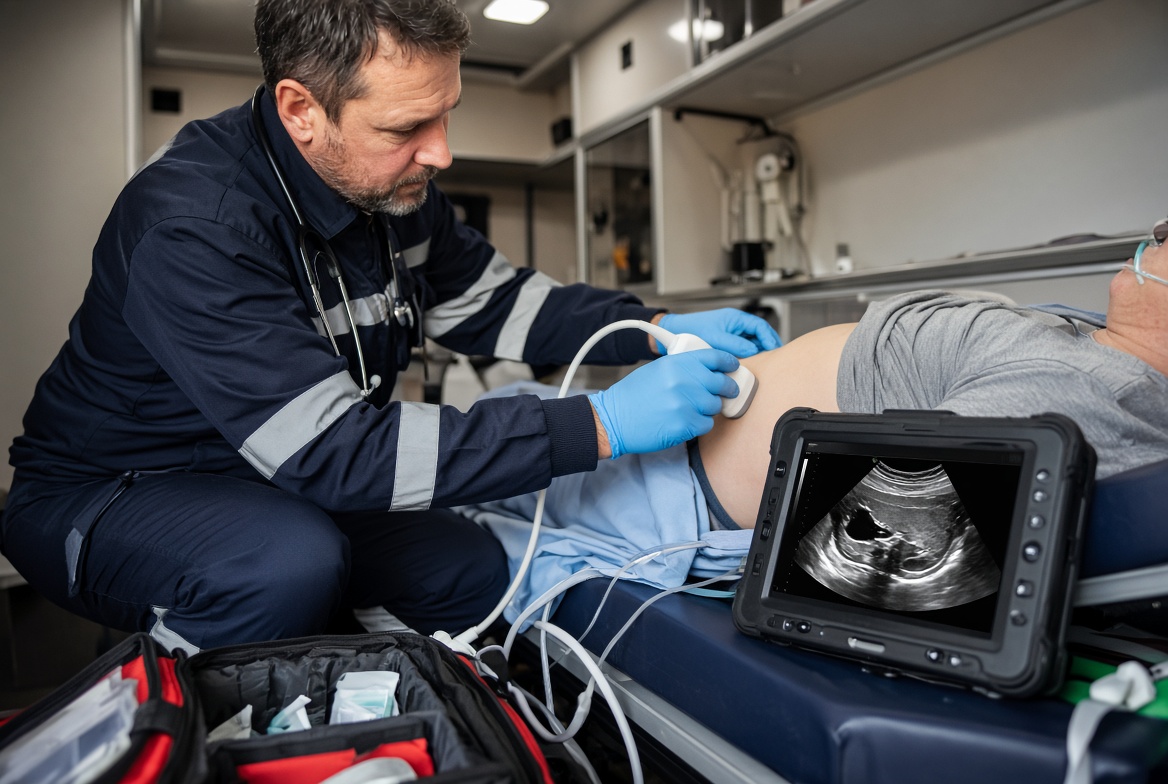
It is 0215 on a two-lane state road. The nearest Level I trauma center is 38 minutes away by ground. A small community hospital with one general surgeon on call is 12 minutes away. Your patient is a 46-year-old driver who struck a tree at highway speed. He is pale, anxious and asking the same questions repeatedly. Heart rate 124, blood pressure 92/60, respirations 26, SpO2 93% on a non-rebreather. A seat belt abrasion crosses his lower chest and upper abdomen. Breath sounds are difficult to discern due to the noise on scene. However, you are ultrasound credentialed and this provides an alternative and reliable diagnostic tool.
Your partner is establishing vascular access, and you begin a Focused Assessment with Sonography for Trauma or FAST exam. After moving through each quadrant of the exam the screen reveals a black stripe of fluid between the liver and the kidney. The anterior chest windows depict the lung sliding normally. You lean forward to the driver and say – priority one to the trauma center, notify the team we are inbound with a hot abdomen.
What Is Ultrasound?
Point-of-care ultrasound (POCUS) is a focused exam performed and interpreted by the treating clinician, at the patient's side, to answer a specific question. Is there free fluid in the abdomen? Is the lung sliding against the chest wall? Is the heart moving? It is not a formal diagnostic study and it does not replace one. It extends the physical exam. This is an important distinction – there is no on-site radiologist interpreting the study. But there could be an agentic radiologist, or even a virtual radiologist watching the live ultrasound via satellite or 5G cellular uplink. This isn’t science fiction this is real technology available today.