Key points
Base excess isolates the metabolic side of acid–base balance. A negative value is a base deficit, and normal is roughly −2 to +2 mmol/L. A base deficit of 6 or more is a well-supported warning threshold for significant shock and likely transfusion. Base deficit or lactate? They’re complementary: base deficit captures the whole metabolic acid load, while lactate is more specific to tissue hypoperfusion — and clinically significant in sepsis. Read them together, alongside pH and PCO₂.
One number can make a difference.
Paramedic Lifeline
© Steve Rinaldi, MBA, NRP
Patient Scenario
Our patient is a 42-year-old restrained driver, awake and talking, complaining of left upper quadrant and left chest pain. The responding paramedic has initiated bilateral large-bore IVs and is infusing NSS. The single vehicle rollover occurred on a two-lane country road, and more than 50 minutes by ground from the nearest Level 1 trauma center. Due to presetting condition and mechanism, the team requested a critical care transport and established an LZ in a nearby field.
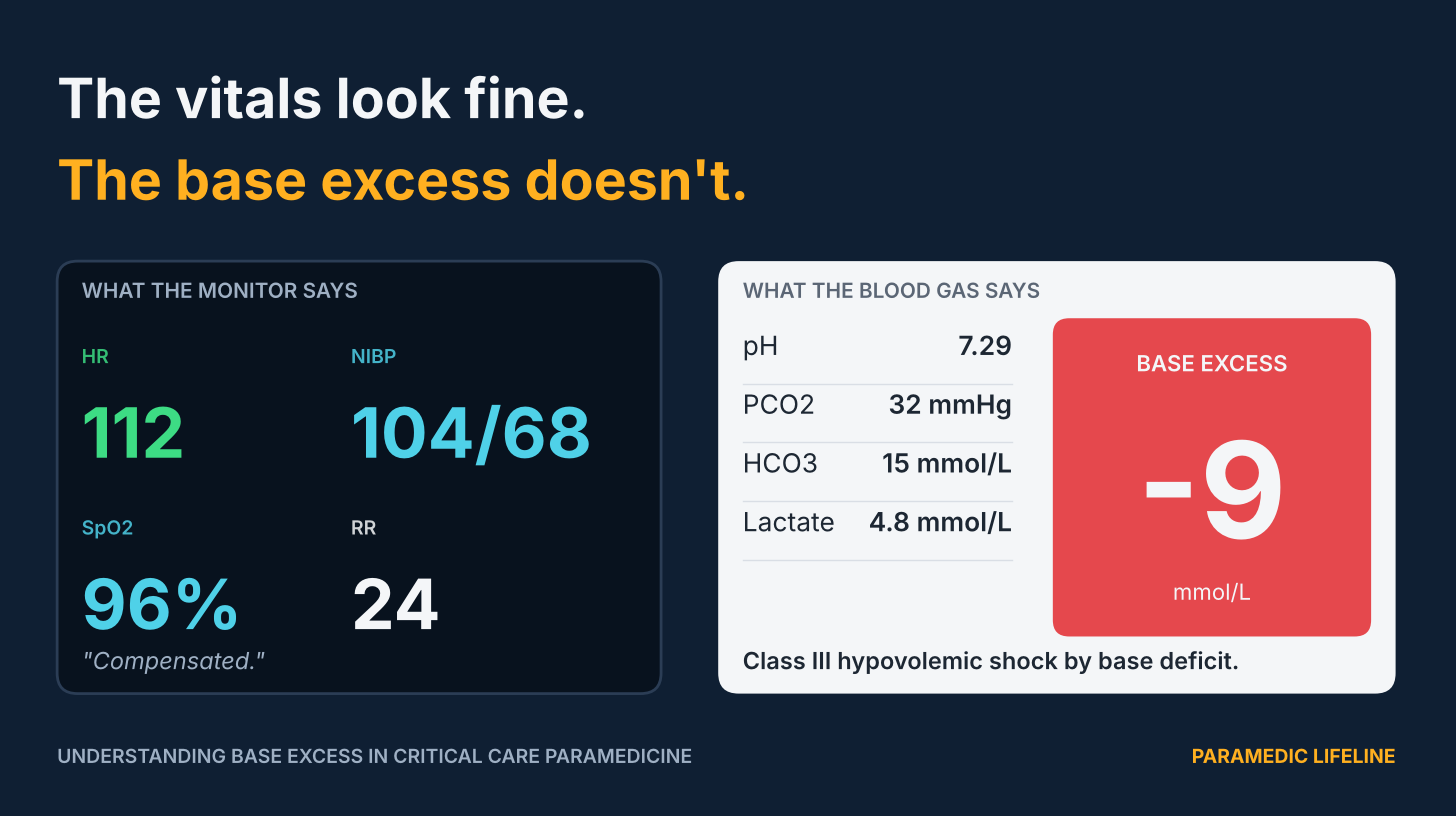
Vital signs appear stable and almost reassuring: heart rate 112, blood pressure 104/68, respiratory rate 24, SpO2 96% on room air. Skin is cool but not mottled. The responding team classifies the patient as compensated, but to be certain you run a venous sample through the point-of-care analyzer. The result: pH 7.29, PCO2 32 mmHg, HCO3 15 mmol/L, lactate 4.8 mmol/L, and a base excess of -9 mmol/L.
What is clinically significant about this test result?
You remember being trained in the Mutschler classification and that of the four classes a base deficit of 9, is a class III, moderate shock criteria that carries a mortality of 24%.10 He is not compensated. This test indicates occult bleeding, likely from a ruptured spleen due to the rib fractures and possibly a hemothorax.