Hypoglycemia, ketoacidosis, pumps and sensors: what the field provider needs to know about the patient whose life depends upon insulin.
A publication of Paramedic Lifeline © 2026
Patient Scenario
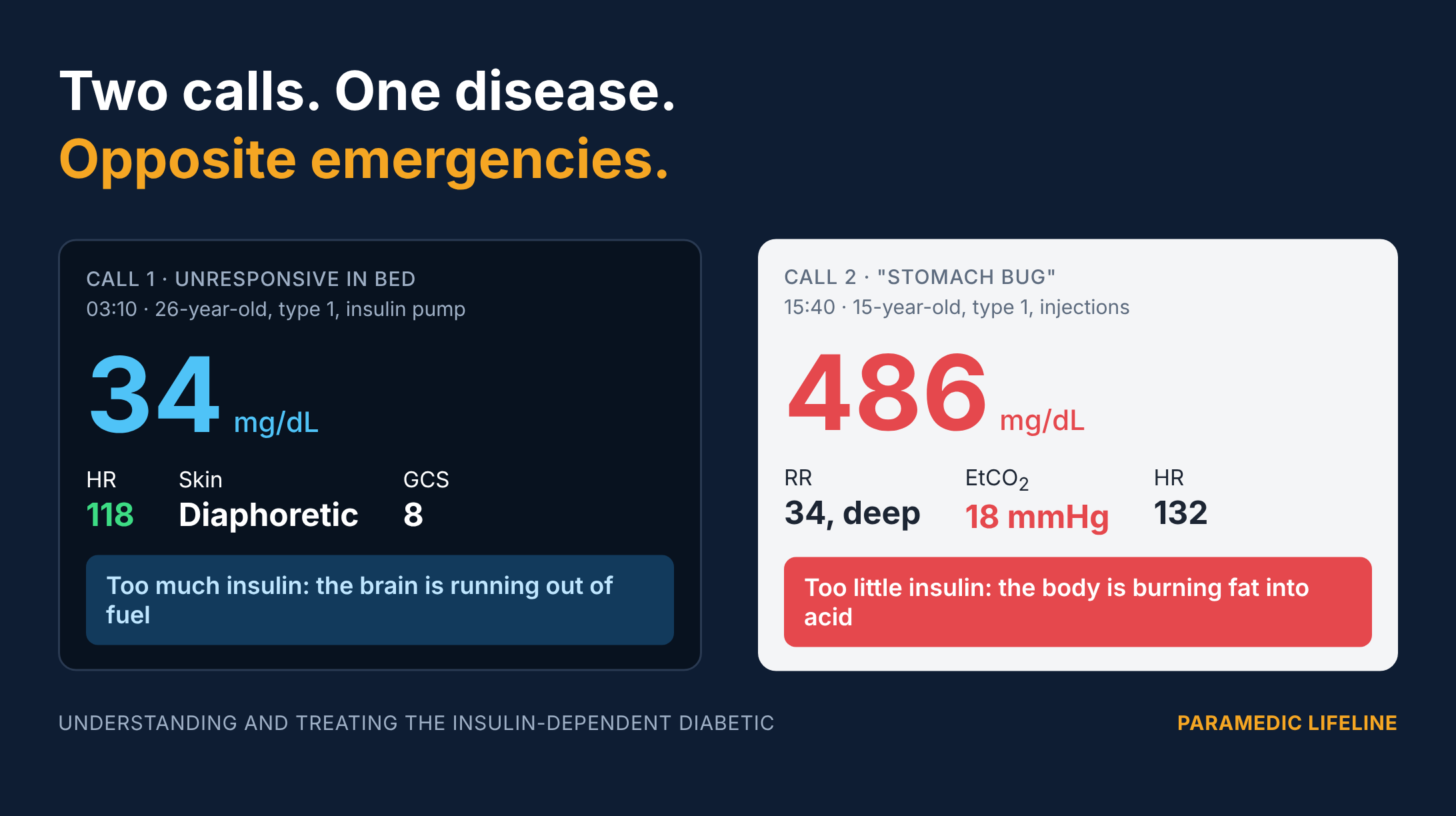
Its o-three hundred, because the call always seems to occur when everyone is asleep at the fire station. You are running the ALS fly car, and Engine 22 a BLS outfit, is rolling from another station closer to the call, but their medic is already committed. The dispatch is to an apartment, third floor where a 26-year-old woman is unresponsive. On arrival she is in bed, pale, tachycardic, soaked in sweat, moaning to pain but not following commands. A small device is observed clipped to her waistband with thin tubing running to her abdomen to a subcutaneous probe. A small white disk is stuck to the back of her arm. Her phone, on the nightstand has been alarming for 40 minutes. A quick finger stick reveals a blood glucose of 34 mg/dL.
This call is reminding you of how you started out the shift at 1500, when you were called for a 15-year-old boy, with a “stomach bug.” He came home from school early, has been vomiting all day and is now sleepy. He takes insulin by injection and has not eaten, so his mother told him to skip his doses. He is breathing deeply and quickly, 34 times a minute, with a heart rate of 132 and dry, cracked lips. His glucose is 486 mg/dL. When you put him on nasal capnography, his end-tidal carbon dioxide (EtCO2) is 18 mmHg. Metabolic acidosis is evident.